
Innovation's Greatest Enemy
Why we resist innovation, even when we need it most

Research-based strategies, insights and inspiration to create value and drive positive change, in the world and in yourself.

Why aren’t we all innovators?
Businesses began systematically innovating using R&D 150 years ago. Scientists have been doing innovation for centuries. Nature has been doing it for billions of years. They all follow the same core process, something I call the innovation cycle. Yet, if this process has been around for so long, why don’t more of us use it? It pays well. The benefits are obvious. Why isn’t everyone innovative? Short answer: Because some of us prefer not to, but at a level that’s largely subconscious. We’re seduced by the alternative.
Questions this article explores
Why aren’t we all innovators, if innovation works so well?
Why do people resist innovation even when it would benefit them?
What is the status quo cycle and how does it work?
What’s the difference between open feedback and closed feedback?
How can people shift from resisting change to learning from it?
The Impulse to Detect & Correct
When I first recognized the innovation cycle, I realized that not everyone follows it. At first, I assumed they must be somehow taking tangents off this cycle. But as I looked more carefully at the many ways that can happen, I realized that those alternatives also fell into a pattern. Just as there’s a pattern that explains being innovative, there’s one that explains resistance to innovation. A pattern, I call the status quo cycle. Let’s begin with a quick example:
My grandson was just 3 years old when he decided he loved hashbrowns, the shredded potatoes you stir up in a frying pan. One morning at a family brunch, we served the other kind of hashbrowns, those potato patties you get at MacDonalds or in the freezer section.
This little guy was obviously annoyed, as he lifted his off his plate and asked in his 3-year-old voice, “What’s this?”
“That’s hashbrowns.” we told him.
His response? “This isn’t hashbrowns! Hashbrowns are supposed to be lumpy!”
That’s how it starts, and we’ve all been doing it since we were that age. Whenever you detect something that isn’t the way you think it should be, your impulse is to correct it—and perhaps complain a little.
Detect & Correct is how we were raised when our parents taught us not to hit little brother and to close the door behind us. It’s how you passed tests in school, how you learned to play a sport or musical instrument, and it’s pretty much how we manage a business, or keep our jobs, right? It’s following directions and correcting our mistakes.
We do this so routinely that we don’t even realize it. I once came across a social media post followed by a long list of negative comments.
A ways down, one comment read: Would everyone stop complaining?!
The next comment read: You do realize that’s another complaint.
A Resistant Feedback Loop
Think of it as a little feedback loop that you create, between you and the realities around you. One that works like the thermostat in your house. It kicks in to correct any deviation it detects from the desired temperature you set.
Nature uses this same kind of feedback to regulate your body temperature, blood chemistry, heart rate, and so on, to keep you alive. Which is kind of important.
When this is your dominant mindset, your brain does the same thing. It prompts you to want to correct anything that doesn’t fit your desires and expectations.
The Status Quo Cycle
It’s a mindset that starts with what you already know or believe. You apply that knowledge to the challenges you face…looking for validation that it worked…which you take as reinforcement of the knowledge you started with, and you repeat. You’re always adjusting back to that predetermined target—whatever you already believe is correct. (Yes, this diagram starts on the right.)
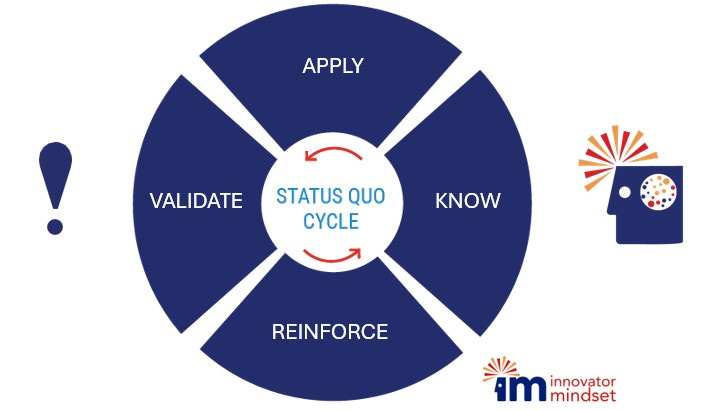
This can be an extremely useful strategy, and it’s all around us. It’s how you keep your car in your lane, how NASA keeps satellites in the proper orbit, and how your smartphone holds onto your calls. It’s the criminal justice system and what you do when you vote to change the government because you don’t like the way it’s being run.
We use the status quo cycle in all sorts of useful ways. But it has some unfortunate side effects. It’s a closed feedback loop that keeps you circling back to the same assumptions, beliefs and opinions, and doing whatever you’re already doing. There’s no off ramp. When this becomes your dominant mindset, you’ve locked down.
That’s why this is called the status quo cycle. It shouldn’t be hard to see how that might interfere with your ability to adapt and innovate.
With this mindset, your brain works like online algorithms. It notices what you respond to and prompts you to seek more of the same—whether that’s the videos you watch, the socks you buy, or the opinions you agree with.
We often cling to the status quo cycle because it represents what’s familiar and reliable. It’s what we know. So, we stick with it even when things are changing around us. Or, maybe because things are changing around us, It feels like a safe refuge, but it sometimes prompts us to behave in ways that are not admirable. At its most intense, a status quo mindset makes us stubborn and arrogant. Dismissive of other perspectives. Determined to be right.
A status quo mindset assumes you already know how the world works. You use it when you’re following an established process, when you’re clear about how you want things to be, and how to get there. (And sometimes you do.) It’s not so great when you face some new challenge. When you need to figure things out. When you’re faced with change and uncertainty.
That’s when the innovation cycle is much more useful. Instead of resisting change, the innovation cycle is an open feedback loop that adapts to change. Both loops are sensitive to changes in the environment. But whereas the status quo cycle strives to correct those changes and restore the status quo, the innovation cycle accepts change and adjusts how it responds. It makes you open to learning and growing, rethinking your views and understanding the world in new ways.
Give yourself—or someone—a Christmas/Hanukkah/Kwanzaa/Yule holiday gift of Innovator Mindset. I’ve added several subscriber PERKS.
The Benefits and Harms of the Status Quo Cycle
When you cling to your prior assumptions and beliefs, it feels principled and comfortable. But it also produces conflict, when how you think things should be is not how someone else thinks things should be. Sound familiar? To make matters worse, the status quo cycle gives you no good way to resolve those conflicts.
I’m not suggesting that you should abandon the status quo cycle. It represents your prior knowledge and expertise. It can be quite useful at times. But when it becomes your primary way of navigating the world—your dominant mindset—it shuts down your ability to adapt and innovate.
When the innovation cycle dominates, it enhances your knowledge and expertise by allowing you to continually update your knowledge as things change.
These two simple patterns explain a lot. When you learn to recognize them in yourself and others, you discover powerful insights. Insights into the realities you face and insights into how you respond.
In my next article, I’ll talk about how the innovation and status quo cycles play off each other, and the profoundly powerful choices that poses. [I’ll also explain why the status quo cycle graphic above appears to be “backwards.”]
When do you find yourself falling into a status quo mindset? Where do you see it in others? What are some of the effects you’ve seen?
Anyone worth their salt will stick up for what they believe is right, but it takes a slightly better person to acknowledge instantly and without reservation when they are in error.
—Andrew Jackson (paraphrased)
Hi, I’m Dennis Stauffer. I’m an internationally recognized expert on the mindset of world class innovators. I’ve studied innovativeness in entrepreneurs in cooperation with the Ewing Marion Kauffman Foundation, and developed innovativeness in students under a grant from the U.S. National Science Foundation. I’m a neurodivergent Emmy Award-winning journalist, author, speaker, independent researcher, social entrepreneur, and innovation practitioner. In other words, I’m still deciding what I want to be when I grow up.
My focus here is on developing the capabilities we all need, to respond to the dramatic changes coming at us, in the world and in our lives. Thanks for being here. Let’s go make the world better.
To learn more about my work, go to:
If you found this article helpful, please share it.