
The Mindset That Creates the Future
Everything We've Ever Invented Was Once Impossible—and Always Possible.

Research-based strategies, insights and inspiration to create value and drive positive change, in the world and in yourself.
If you like what you find here, please consider supporting this work and this community with a paid subscription.
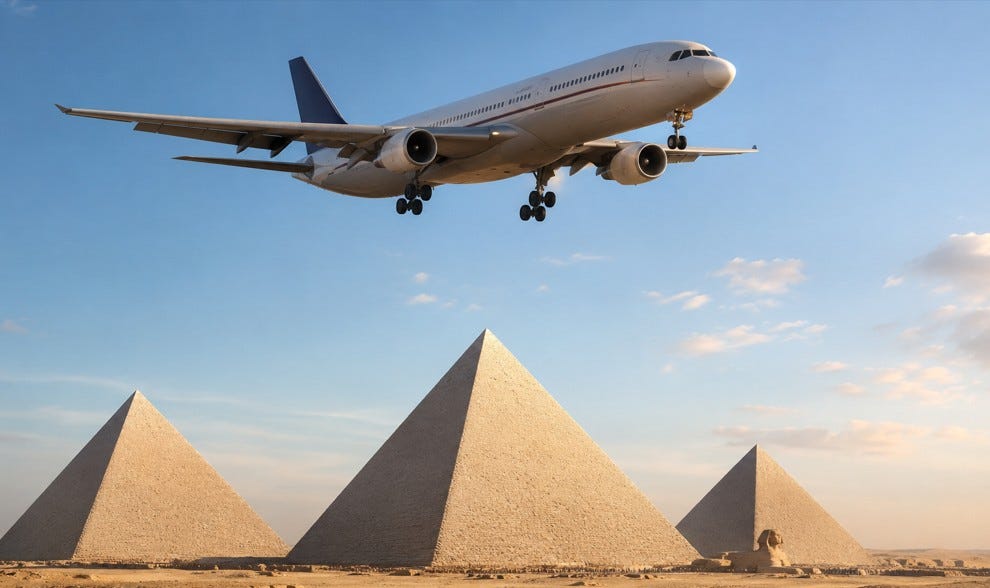
Do a thought experiment with me.
Imagine that you’re on a transatlantic flight that somehow slips through a time warp and ends up over ancient Egypt. (Work with me here. It’s just a thought experiment.)
Questions this article explores
What does it mean for something to be possible?
How do innovators define what’s possible?
Can something be possible before we know how to do it?
How does invention expand human possibilities?
A Strange New Reality
You look down and see the shiny new pyramids and maybe the Sphinx. But of course there’s no runway to land on, and fuel is getting low. So, the pilot sets down in the desert. This will definitely complicate baggage collection and risk missing your connecting flight. But there’s a more urgent problem.
The locals are so terrified by this giant monster that appeared out of the sky, that they decide to attack. As the chariots race toward the plane, the pilot realizes that the prudent thing to do is get out of there, and she begins taxiing for take-off.
So, here’s the question: Will that plane fly?
The answer’s pretty obvious isn’t it? Of course it will. It just did. There’s no way to refuel. No one to talk to on the radio. And the time warp thing is still a problem. But fly the plane? Sure. Why not?
Everything we know about chemistry and physics and aerodynamics was just as true then as it is now. It’s always been possible to build and fly a heavier-than-air machine in the sense that the rules of the universe permit it. We just didn’t know how until a little over a century ago.
Two Definitions
That means there are two distinctly different ways to define what’s possible, 1) what it’s currently possible to do, and 2) what might be possible is we can figure out how.
If I asked you whether something was possible today, your answer would probably be based on your understanding of our current technologies and capabilities.
An electric car? Sure.
Finding a restaurant using your phone? No doubt.
Teleportation Star Trek style? No.
But that’s not how innovators define what’s possible. For them, it’s an entirely different question.
The question you answered was: Can we go do that?
The question an innovator asks is: Can we figure out how to do that?
Based on the first definition, teleportation is clearly impossible.
But based on the second definition, it’s an open question. We don’t know, and we won’t know, until someone figures out how to do it. The fact that we haven’t figured it out yet, doesn’t mean we won’t or can’t.
If you asked someone before the time of the Wright brothers whether powered controlled flight was possible, or whether communicating through the air was possible before radio was invented, they would have said, No.
And yet people like Marconi and the Wright Brothers set out to invent those technologies because they believed it was possible.
Potentially Possibilities
What’s possible is always open to discovery and invention. We have the power to create the possible whenever we have the courage to explore and experiment with possibilities. Interstellar travel? An invisibility cloak? Who knows?
What’s ultimately impossible? Not much that we can say for sure. Maybe nothing. We don’t know. All we can say is we don’t know how yet. No doubt many things are possible that we can’t yet do. That’s true of our technologies, and it’s true in your life.
When you think like an innovator—with an Innovator Mindset—you believe all sorts of things are possible. And those beliefs are what prompt you to pursue all those amazing possibilities.
What might be possible for you, if you can figure out how to do it?
The universe is full of magical things patiently waiting for our wits to grow sharper.
– Eden Phillpots
Hi, I’m Dennis Stauffer. I’m an internationally recognized expert on the mindset of world class innovators. I’ve studied innovativeness in entrepreneurs in cooperation with the Ewing Marion Kauffman Foundation, and developed innovativeness in students under a grant from the U.S. National Science Foundation. I’m a neurodivergent Emmy Award-winning journalist, author, speaker, independent researcher, social entrepreneur, and innovation practitioner.
In other words, I’m still deciding what I want to be when I grow up.
My focus here is on developing the capabilities we all need, to respond to the dramatic changes coming at us, in the world and in our lives. Thanks for being here. Let’s go make the world better.
To learn more about my work, go to:
If you found this article helpful, please share it.